AI voice agents improve customer service efficiency, but misunderstandings still happen. Learn how smart human handoff and escalation strategies reduce frustration, ensure compliance and improve customer experiences.
- 1Implement a smart AI voice agent human handoff strategy to prevent customer frustration and ensure a seamless transition to live agents.
- 2Design escalation frameworks that preserve interaction context, including customer identity, history, and intent, to avoid forcing customers to repeat themselves.
- 3Utilize smart routing to direct customers to the most appropriate agent based on issue type, priority, and sentiment analysis, rather than generic queues.
- 4Recognize that AI voice agents struggle with complex, sensitive, or emotionally charged interactions and require human empathy and intelligence.
- 5Leverage AI to assist human agents in real-time with suggested responses, knowledge retrieval, and regulatory guidance to improve efficiency and accuracy.
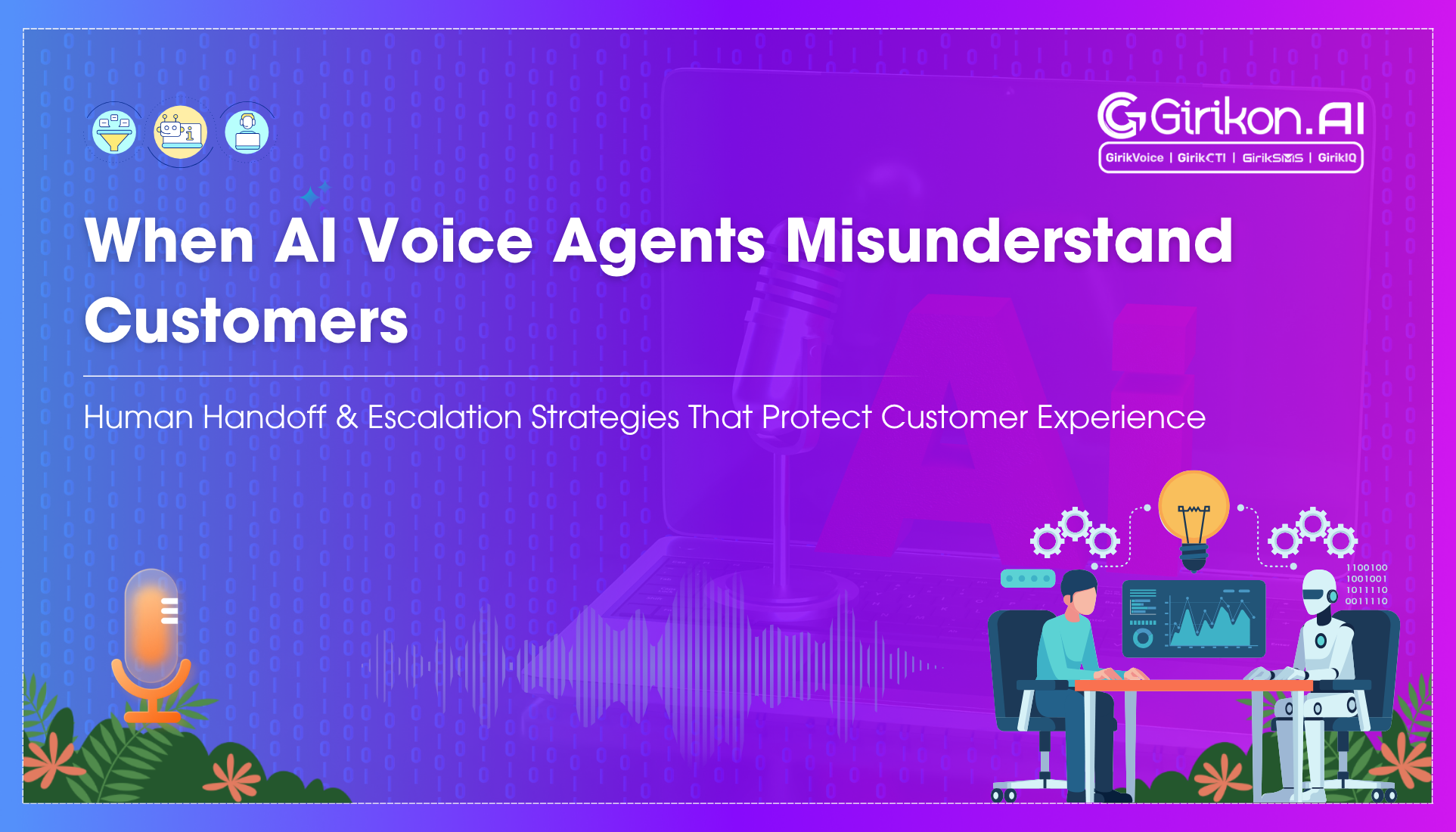
When AI Voice Agents Misunderstand Customers: The Enterprise Guide to Human Handoff & Escalation
Enterprise customer service has undergone transformation with the advent of AI. Gone are the days when live agents had to tackle every customer manually. Today, AI-powered voice agents are helping businesses manage high call volumes, decrease response times - delivering quick resolutions across several channels.
Besides answering calls, resolving routine requirements, validating customers, AI-powered voice assistants also automate redundant workflows on a scale. While forward-looking organizations have already deployed conversational AI to reduce functional costs and optimize awareness. Yet the irony is that despite remarkable advancements, AI systems are far away from perfect. Customers have to deal with systems that fail to understand accents, detect immediacy, and more thereby eroding trust, increasing frustration, and creating risks.
This is where smart escalation becomes crucial. Transitioning seamlessly from automation to a live representative isn’t optional, it’s crucial. This is where the need for an AI voice agent human handoff strategy reveals whether AI augments client experience or is a source of friction.
A well-designed ai voice agent human handoff strategy determines whether AI enhances customer experience or becomes a source of friction. This guide investigates why AI voice agents struggle, how escalation frameworks should be designed by enterprises, and why hybrid models are becoming a must-have for modern customer engagement.
Why AI Voice Agents Need Human Support for Complex Interactions?
Voice AI systems today use voice recognition, conversational comprehension, emotion detection, and more to augment client engagement. Despite significant developments, real-world interactions are usually not easy for AI systems to interpret. AI voice agents struggle with multilingual interactions, ambiguous intent, background noise, disruptions, and rapid swapping of topics during calls.
While an AI agent might address a certain part of an interaction, it might fail to understand the broader context - leading to customer dissatisfaction. Although enhancements in training models and analytics continue to augment speech interaction accuracy, enterprises couldn't completely rely on automation for sensitive, complex, or sophisticated client interactions that need human empathy and intelligence.
What are the Outcomes of Failed AI Conversations?
Customer Frustration
Repeated conversational errors can irritate customers, especially when they fail to connect with a live agent after multiple communication inconsistencies. Poor interactive experiences often fortify call abandonment rates, lower satisfaction scores, declining loyalty, and more complaints across various channels.
Detection of Negative Sentiment
Modern AI voice systems can assess poor customer perception by evaluating speech patterns, tone and context. They can identify signs of anger, irritation, confusion, and immediacy during interactions. This helps businesses respond proactively. However, when emotional intensity increases, human intervention becomes crucial to preventing unfavorable customer reactions.
Compliance-sensitive Requests
Discussions that are regulation-heavy usually require human supervision to ensure accountability and compliance. Certain situations involving healthcare sanctions, fraud investigations, insurance claims, and legal complaints are too sensitive to totally rely on automation. Seeking support from live agents ensure fortified ai voice compliance management, optimizes decision-making transparency, and helps businesses minimize regulatory risk.
What is an Ideal AI Voice Agent Human Handoff?
Not all AI voice agent handoff experiences are effective. Weakly designed transfers create more frustration than the actual AI issue. A successful ai voice agent human handoff should include the following elements:
Preservation of Context
This is critical during escalation, as clients get irritated when forced to repeat details. During handoff, live agents must receive client identity, interaction history, detected intent, sentiment insights, CRM data, prior actions, and discussion transcripts. This hassle-free transfer augments continuity, minimizes handling time, and offers more efficient client support experience.
Smart Routing
Escalation workflows should not route customers into non-specialized support queues without proper context. Rather, AI systems should smartly direct discussions based on parameters such as type of issue, easy-to-understand language, priority level, product category, immediacy, and real-time sentiment analysis - ensuring customers are associated with the most appropriate agent.
Agent Assistance in Real-time
Even after an interaction is routed to a human agent, AI can support agents in real time through suggested responses, instant retrieval of knowledge, suggestions for next-best actions, regulatory guidance, and automated call-summarization. This approach reinforces the hybrid ai human call center model by augmenting operational efficiency, reducing burden on agents, faster problem resolutions, and augmenting overall service quality.
Channel Continuity
Clients struggle shifting from one channel to the other during support journeys. Seamless channel continuity ensures interactions, client history, and interaction context remain tied across every point of contact. This inhibits customers from retelling information, enhancing consistency, accelerating resolution of issues – delivering a more unified and identified client experience across channels.
Why AI Voice Compliance Matters in Human Escalation Flows?
AI voice compliance is a determining factor in enterprise interactive AI deployments. Organizations are required to ensure transparency, data protection, audit readiness, consent governance, and efficient escalation management. Creating robust frameworks must include recordings of interactions, monitoring records, human intervention control mechanisms, secure management of sensitive client data, and detailed escalation records.
Monitoring why escalations were initiated, what prompted transfers, and how problems were fixed optimizes oversight, regulatory readiness, and overall customer confidence.
| Compliance Area | Importance During Escalation | Business Benefit |
|---|---|---|
| Consent Management | Ensures customers understand AI involvement | Reduces legal and regulatory risks |
| Interaction Recording | Maintains audit trails during transfers | Supports compliance investigations |
| Data Protection | Safeguards customer information | Builds trust and security |
| Escalation Tracking | Documents reasons for human intervention | Improves process optimization |
What is the Future of AI Voice Support?
The future of client service doesn’t rely entirely on automation. The collaboration between AI and human agents ensures a bright future ahead.
Organizations have realized that customers do not prefer entirely AI-driven experiences. Rather, they expect prompt responses, tailored engagement, precise and prompt resolution of issues, and access to human intelligence and empathy when circumstances become complex.
To succeed, organizations will have to use AI strategically while ensuring hassle-free transitions to human support and capability whenever required. In a hybrid ai human call center, handoff is not viewed as an automation failure, but as an essential aspect of the overall customer experience strategy.
The strongest customer support models combine AI efficiency with human expertise. Enterprises that invest in intelligent escalation workflows can improve service quality, maintain compliance, and strengthen customer trust while benefiting from automation at scale.
Summary
Disagreements are inevitable in business communication. The real advantage lies in how effectively businesses manage those situations. A strong ai voice agent human handoff strategy and smart conversational ai escalation processes help reduce dissatisfaction, augment efficiency, fortify ai voice compliance, and maintain customer trust.
As interactive AI adoption grows, seamless ai call transfer to agent capabilities and improved ai voice agent accuracy will become crucial to deliver humanized client experiences.